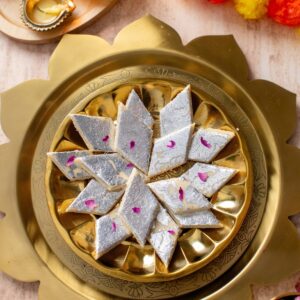
Homemade Kaju Katli (Soft, Milky & Melt-in-the-Mouth)
Kaju Katli is a traditional indian sweet (mithai) made with cashews. It has a melt in the mouth texture and you will need ground cashews, sugar and water for making these fudgy thins.
Save The Recipe!
Ingredients
- 200 g raw cashew powder
- 40 g milk powder I use Nido, don't use non fat
- 150 g granulated sugar
- ⅓ cup water
- 2 teaspoon ghee divided
- edible silver foil optional, purely for aesthetics
Instructions
Make Cashew Powder
- Start with cashews that are completely dry and at room temperature. This is especially important if you store your nuts in the refrigerator. Take them out the night before or for few hours and spread them on a clean kitchen towel so they can come to room temperature and air dry.
- Cashews are naturally high in fat, so any moisture or condensation can make them clump while grinding. And if you grind them for too long, they can quickly go from a fine powder to a greasy paste. For kaju katli, we want a dry, loose and finely ground cashew powder.
- Add the cashews to a completely dry blender jar. Work in short pulses of 15-20 seconds rather than running it continuously. We don't want the kaju powder to heat up. Stop and check the texture in between, and resist the temptation to keep blending just because you see a few slightly larger pieces.
- Sift the ground cashews through a fine sieve. This removes any larger pieces and gives the katli a smoother, finer texture. Do not keep regrinding the small amount of cashew pieces left in the sieve. Since the quantity is so small, they will take longer to grind and are more likely to release their oils and turn pasty.
Save those leftover cashew pieces. I usually keep them aside and use them later for a wet cashew paste in curries, gravies or other recipes.
Make The Cashew Dough
- Choose a wide, heavy-bottomed pan. A stainless steel pan(10 inch or larger) works perfectly fine, but I personally prefer nonstick for kaju katli. The mixture releases more easily from the pan, and I feel there is much less sticking and wastage.
- Combine the sugar and water in the pan and set it over low medium heat. Give it a gentle stir once with a rubber spatula, then let the sugar dissolve completely. The syrup may look quite thick at this point, but resist adding more water.
- Keep flame on low medium and let the sugar dissolve. Once the sugar has dissolved completely and is bubbling, you are ready for the next step. We are not looking for any string consistency.
- Lower the heat, if needed, and add the sifted cashew powder along with the milk powder. Mix immediately, pressing out any small lumps with the spatula as you go. At first, the mixture may look loose and slightly lumpy, but it will become smoother as it cooks.
- Set a timer for 10 minutes and brace yourself for some arm work now!From this point onward, keep the heat low and stir continuously. Keep stirring and scraping continuously so the mixture cooks evenly and doesn't catch at the bottom. It is the natural tendency of cashews to stick.Keep scraping and mixing back the sides
- At about 5 minute mark, you will see that the mixture is beginning to thicken and few bubbles start appearring. At this stage, the mixture has fully warmed up and raw cashews are beginning to cook. It also higher tendency to stick so continously mix.
- After 6 minutes, add 1 teaspoon of ghee along with 2-3 drops of rose essence if using. The kaju katli mixture will continue to thicken for next 3-4 minutes. At this stage, the cashews sticking to the sides of the pan gets super dry so don't mix them back.
- At 9 minute mark, the mixture will leave the sides of pan and start resembling a soft, sticky dough.It will begin to clump up around the spatula. If you try to bring the mixture together in one place, it will slowly spread out. It took me exactly 10 minutes to reach that stage. Be careful not to overcook it. A mixture that becomes too dry in the pan can give you crumbly katli and may crack when you try to roll it.
- You can add few drops of ghee if dough is not coming together. Remove from heat. One way to check the texture of the dough is by dipping your rolling a tiny amount of dough with wet fingers. It should be soft and supple, not sticky.
Knead, Roll And Cut the Katli
- As soon as the mixture is ready, transfer it to a lightly greased work surface or a sheet of greased parchment paper. Let it cool just until it is comfortable enough to handle. You don't want it completely cold because the dough is much easier to smooth and roll while still warm.As soon as it is okay to touch while warm, start kneading it. Kneading the dough bring out the real texture. Don't skip this step else the katli won't form or they will be crumbly.
- At first use spatula to knead the kaju mixture.Then, knead by folding sides of parchment paper. Knead and press the mixture to smoothen out. Knead for about 4-5 minutes to completely smoothen it. Do not press very hard while kneading else the cashews will start oozing their oil.
- Once kneaded, flatten the kaju katli mixture slightly and place a parchment paper on top. Using a rolling-pin, roll it out to a ¼ inch thickness. Place silver foil over the rolled dough. Let cool and then using a sharp knife, cut into diamonds or square shape.
- Since these have milk powder, store kaju katli in an air tight container for a week in the refrigerator. Leave refrigerated kaju katli on kitchen counter for 20 minutes before serving.
Tried this recipe?Let us know how it was!